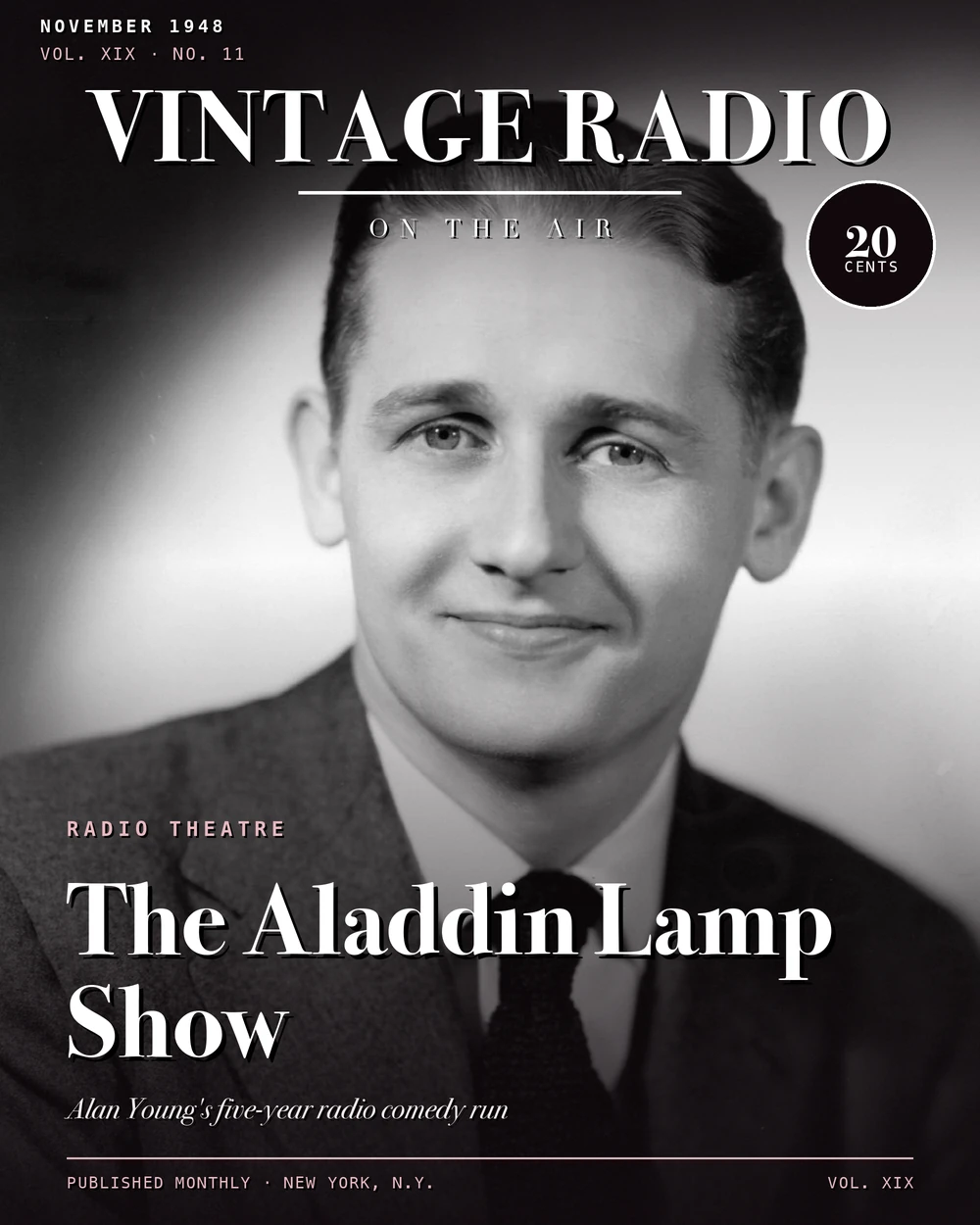
The Aladdin Lamp Show
A Note on the Title
This page is filed under "The Aladdin Lamp Show," but the program covered here is The Alan Young Show — the five-year situation comedy Young headlined on NBC and ABC between 1944 and 1949. None of the surviving documentation on Young's radio career connects him to a sponsor or program called Aladdin Lamp, and the relationship between the two titles, if there is one, is not established by any source the page draws on. Readers arriving here looking for an Aladdin Lamp-branded series should treat the title as a cataloging artifact; the substance of what follows is The Alan Young Show.
How a Bashful Young Canadian Broke Into American Radio
Alan Young didn't fit the mold of the hard-edged, fast-talking radio comedian who dominated American airwaves in the 1940s. He was born Angus Young on November 19, 1919, in North Shields, Northumberland, to a Scottish shipyard worker who moonlighted as a tap dancer and an English mother who sang. The family moved to Edinburgh when he was a toddler and then emigrated to West Vancouver when he was six. Severe childhood asthma kept him bedridden for long stretches, and the radio at his bedside did what radio did for a lot of sickly kids in that era — it became the world. He credited Christian Science, in a 1967 interview, with eventually healing the asthma. The illness gave him radio; radio gave him a career.
He made his on-air debut at 12 or 13, was doing impersonations on a Saturday-night show called Bath Night Revue by 15, and by 17 was writing and performing his own comedy-variety material for the CBC. In early 1937 he joined CJOR in Vancouver as assistant to program director Dick Diespecker, scripting and appearing in shows including Signal Carnival. His earliest solo effort, Stag Party, featured him as virtually the entire act. He was fired from one early job after asking for a raise from $15 a week, but later earned $150 a week doing situation comedy at CBL. Somewhere along the way he legally changed his first name from Angus to Alan — partly, he said in his autobiography, because Americans kept mispronouncing it as "Agnes," and partly because listeners hearing the name Angus expected a comic who would deliver nothing but Scottish dialect material.
When the war came he tried to serve. He enlisted in the Royal Canadian Navy and resigned his commission after learning he'd be spending it writing scripts for a naval entertainment program. He tried the Canadian Army next and was rejected for his health. The asthma that had given him radio kept him out of uniform — and, by accident, kept him available when American radio came calling. A trade journal that caught his summer 1944 NBC debut described it as "routine situation comedy" laced with "rapid-fire gags," which wasn't exactly a rave, but it was enough: the summer show, a fill-in for Eddie Cantor sponsored by Sal Hepatica and airing Wednesdays at 9:00 PM, led directly to Young getting his own series.
That series premiered on NBC on June 28, 1944, and wound through two networks and multiple sponsor arrangements before ending on July 5, 1949. Young played essentially the same character throughout — himself, more or less, a bashful young man perpetually out of his depth. His wife Ginni later confirmed that the bashfulness wasn't entirely an act. Newsweek, sizing him up during his radio years, described him as "a meek, washed-down blond with saucer eyes and a perpetual woebegone manner" with "flashes of Harold Lloyd and Charlie Chaplin." That quality — gentle, slightly bewildered, never aggressive — defined the show's comedy from beginning to end.
The Network Years and the Rotating Cast
After the first NBC run wrapped on September 20, 1944, the show moved almost immediately to ABC, premiering there on October 3 of the same year. The ABC run, sponsored by Ipana, lasted until June 28, 1946, and introduced some of the supporting cast that would give the show its shape. Jean Gillespie and Doris Singleton both played Betty, Young's girlfriend. Ed Begley played Papa Dittenfeffer — Betty's crusty father — and the combination of Young's fumbling charm against Begley's bluster gave the comedy a reliable engine. Jay Sommers and Will Glickman handled the writing.
Doris Singleton, who played Betty on ABC, had a career that ranged well beyond this show. She'd trained as a ballerina for three seasons with the organization that became the American Ballet Theatre, started as a vocalist with Art Jarrett's orchestra in the late 1930s, and had worked alongside George Burns and Gracie Allen, Bob Hope, and Jack Benny. She met Lucille Ball during a My Favorite Husband broadcast in 1948 and later became recognizable to millions as Lucy Ricardo's neighbor Carolyn Appleby on I Love Lucy, appearing in ten episodes between 1953 and 1957.
The show returned to NBC on September 20, 1946, with Ipana still as sponsor, running Fridays at 8:30 PM before shifting to 8:00 PM. That run ended May 30, 1947. After a gap, the show came back for a final NBC run beginning January 11, 1949, now sponsored by Turns and airing Tuesdays at 8:30 PM. Louise Erickson took over the role of Betty. Don Wilson announced. The Re-galaires — Sue Allen, Fay Reiter, Ginny Reese, and Ginni Young — served as vocalists, and George Wylie provided the music. Helen Mack produced and directed.
The Character Who Stole the Final Season
The single most talked-about addition to the show's final NBC run was Jim Backus as Hubert Updike III, a snooty, self-regarding playboy whose ancestors had reportedly landed at "Cadillac Rock." The character delivered lines like "Careful, or I'll have your mouth washed out with domestic champagne." Young had sought out Backus specifically, looking for someone with "an over-the-top delivery" who could "convey an air of snootiness…to be a sharp contrast to Young's much quieter on-air persona." It worked. By September 1947 a notice in the Dunkirk Evening Observer described Backus as "a radio comedian who has appeared on as many as 15 radio programs a week" and noted he was "probably best known as Hubert Updyke of The Alan Young Show."
The Updike character had a longer life than the show itself. Writer Sherwood Schwartz — who would later create both Gilligan's Island and The Brady Bunch — is credited with sharpening the character's definition, and the aristocratic accent and manner Backus developed for Updike became the direct blueprint for Thurston Howell III on Gilligan's Island years later. Other supporting players in the final run included Nicodemus Stewart, Hal March, and Ken Christy, but Backus was the one who generated the most noise.
Young's radio career during this period had a quality that contemporaries noticed: he always seemed to be on the verge of breaking through to a larger audience, but something kept the breakthrough elusive. He was signed as a regular on The Jimmy Durante Show in 1948 and finished that year appearing on both Durante's show and his own new series simultaneously.
What Came After
When the radio show ended in the summer of 1949, Young took his act on the road, touring the U.S. comedy circuit — reportedly bringing along, in one account's colorful phrasing, "his bagpipes and jokes." He wrote a television pilot for CBS in 1950, and The Alan Young Show debuted on CBS television on April 6, 1950, having first aired locally on the West Coast starting March 14, 1950. The TV version was a variety sketch-comedy show featuring regulars including Polly Bergen in her national television debut, Ben Wright, Joseph Kearns, Mabel Paige, Phillips Tead, and the Lud Gluskin Orchestra; Nina Bara was a featured comedienne. Ralph Levy and Dick Linkroum produced; the writing staff included Joe Connolly, Bob Mosher, Sherwood Schwartz, Leo Solomon, Dave Schwartz, Nate Monaster, Stanley Shapiro, and Young himself. When the show came back from hiatus in February 1953 as a conventional sitcom with Young playing a bank teller, Dawn Addams joined as his girlfriend, Melville Faber played his son, and John Heistand announced. That final format alternated weeks with Ken Murray's program under the umbrella title Time to Smile, and the run ended June 21, 1953.
The television run earned genuine recognition. In 1951 the show received the Primetime Emmy Award for Outstanding Variety Series, and Young won the Best Actor Emmy as well, beating out José Ferrer in a combined category that covered variety, comedy, and drama alike — a result that generated some controversy at the time. TV Guide called Young "the Charlie Chaplin of television." The New York Times found that he "had some excellent sketches" in the early episodes but criticized his "repetitive opening monologues" and noted an over-reliance on writers when the scripts weren't strong. Billboard, reviewing a September 1950 episode, called him "one of the most original performers in video."
Young's film work ran alongside the television years and after. He'd begun on screen with Margie in 1946 and followed with Chicken Every Sunday and Mr. Belvedere Goes to College in 1949, Aaron Slick from Punkin Crick and Androcles and the Lion in 1952, and Gentlemen Marry Brunettes in 1955. The two credits that gave him the most cultural staying power came later: Tom Thumb in 1958 and George Pal's The Time Machine in 1960, in which he co-starred with Rod Taylor and played James Filby — a role that, at age 40, also required him to portray an 18-year-old.
His best-remembered role came on the CBS-TV series that ran from 1961 to 1965, in which he played Wilbur Post — a man whose horse, Mr. Ed, could talk. The pilot had been created and financed by George Burns' production company, and the show ran in syndication before moving to CBS in October 1961, an unusual path for a network program. The voice of Mr. Ed was provided by Allan "Rocky" Lane, who chose not to be credited. Young received a star on the Hollywood Walk of Fame at 6927 Hollywood Blvd for his contributions to radio. He took a hiatus from Hollywood in the late 1960s to create the broadcast division of the Christian Science Church. Beginning in 1974 he voiced Disney's Scrooge McDuck, a role he held until his death — including in the Academy Award-nominated short Mickey's Christmas Carol in 1983 and throughout the DuckTales animated series from 1987 to 1990. And from 1994 onward he returned to radio drama in earnest, playing at least eight characters on Adventures in Odyssey, most notably antique dealer Jack Allen. He died on May 19, 2016, at the Motion Picture & Television Country House and Hospital in Woodland Hills, California, at the age of 96.